SINTEZO 8
Circularity:Framework to Culture
Reading Entangled Environments
Caroline AustinPhotography, video, and 3D scanning are among the most powerful tools we have for shaping how we understand the world — but they are tools built for separation. Every lens draws a boundary. Inside the frame sits "Nature": framed, contained, available for our contemplation. Outside sits everything else, including us. We have spent centuries curating this distance, and we have become very good at it. Nature as backdrop. Nature as spectacle. A thing to be looked at, rather than something we are living within.
The question this raises is a simple one, even if the answer is not: how do we move from seeing nature as something out there — beyond the glass, available for consumption or conservation — toward understanding ourselves as genuinely embedded within it? Not extractive, but circular. Not observers, but participants.
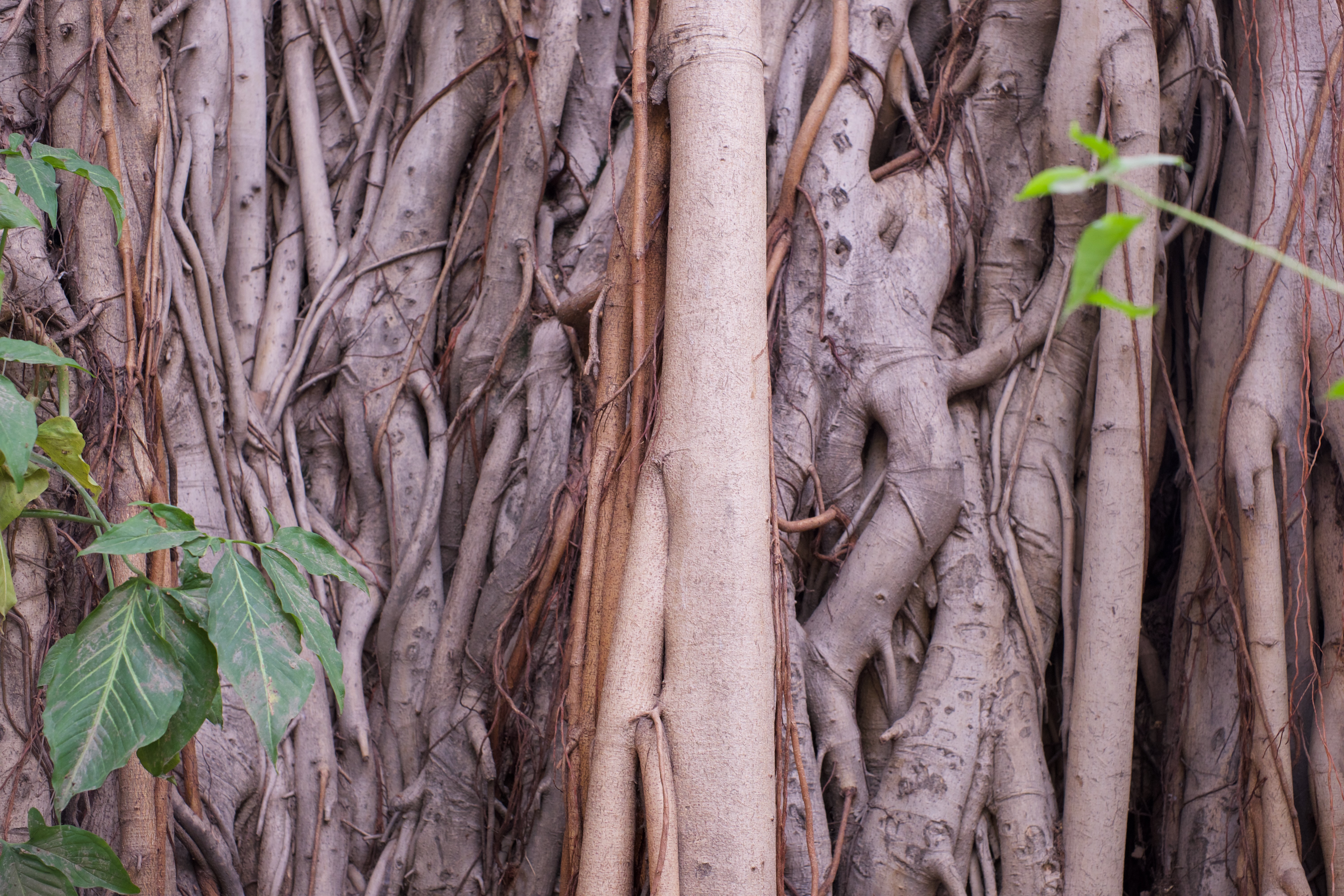
The imagery of fig and neem trees running through SINTEZO 8's Circularity Edition is one attempt at an answer. By introducing pins, scissors, and other everyday objects to rupture the photographic frame, these images make visible what photographs usually conceal — that they are constructed objects, not neutral windows on the world. That rupture is an invitation: to pause, to notice the apparatus, and in doing so, to imagine a different relationship with what lies on the other side of the frame.
The question this raises is a simple one, even if the answer is not: how do we move from seeing nature as something out there — beyond the glass, available for consumption or conservation — toward understanding ourselves as genuinely embedded within it? Not extractive, but circular. Not observers, but participants.
The imagery of fig and neem trees running through SINTEZO 8's Circularity Edition is one attempt at an answer. By introducing pins, scissors, and other everyday objects to rupture the photographic frame, these images make visible what photographs usually conceal — that they are constructed objects, not neutral windows on the world. That rupture is an invitation: to pause, to notice the apparatus, and in doing so, to imagine a different relationship with what lies on the other side of the frame.
![]()
![]()
Working the Gaps: Circularity, Place, and What We Learn Along the Way
Cassandra CazzulinoTownsville is a place of possibility.
It is one of Australia’s fastest-growing regional cities, yet it still holds a strong sense of closeness. People run into each other. Stories travel. Opportunities surface, sometimes quietly, sometimes all at once. It is a city confident enough to grow and grounded enough to stay connected.
Over the past three years, alongside a wide range of programs and initiatives, I’ve spent time paying close attention to what I’ve come to think of as the gaps, the spaces people move through when linear pathways don’t reflect how they actually build ideas, businesses, or livelihoods.
I did not arrive with a theory of circularity. I arrived with questions, shaped by the people standing in front of me seeking help, by daily practice, and by a growing awareness that many of the challenges people face do not respond well to linear structures.
![]()
![]()
![]()
Steve Hannah, Paul Bull and Jason Lange
Atlas Soils
When you live in Townsville long enough, certain things become hard to ignore.
You notice how quickly the city heats up after rain. You notice where the water goes when it runs off streets and yards. You notice how often our valuable soils are scraped, compacted, built on, and then watered into submission. And if you spend enough time around soils, construction sites, lawns, drains, or the reef, you start to see the same pattern repeating itself over and over again.
The moment it really landed for us wasn’t dramatic. It was standing on the Castle Hill lookout after a Movember walk, looking out over the Townsville CBD to Middle Reef only a few kilometres from our favourite restaurants. Offshore and visible in good conditions, sits this extraordinary and mammoth living system, a city in its own right, built entirely from relationships, sunlight, water, and time. No waste. No trucks. No complaining. No landfill. Everything reused, recycled, repurposed, or transformed with partnerships.
As dads, that contrast matters.
![]()
A unique 19th-century Kantha (hand-embroidered textile) from Bengal, now in the Stella Kramrisch collection at the Philadelphia Museum of Art, contests the common understanding of kantha as simple domestic folk embroidery. Made entirely from locally grown, spun, and woven cotton (kapas) and embroidered with cotton threads, the work embodies circular, place-based production. It was collected from Jashore (now Bangladesh), near the Sundarban Delta mangrove ecosystem. The composition features a central hibiscus flower — not a human — encircled by paisleys, marigolds, mandalas, and geometric patterns, and can be "entered from any direction," compared by the author to Kurosawa's Rashomon effect. Diagonal punkahs (fans), mangroves, fish, birds, animals, and humans are all given equal visual weight, suggesting a feminised, non-extractive worldview in which the maker positions herself as creator, nurturer, and observer — a custodian of place with embodied ecological knowledge.
Circularity operates on multiple levels throughout this work: material reuse, compositional structure, spiritual practice, and generational continuity through ancestral touch. The design blends Persian, Hindu, and European stylistic influences, reflecting Bengal's syncretic cultural landscape while potentially serving as an aspirational counter-narrative to British colonial turmoil. Through the precise, error-free stitching, the unknown woman maker enacts custodianship of her world — manifesting abundance and possibility, where ecology, spirituality, creativity, and care are intrinsically intertwined rather than separate.
![]()
![]()
![]()
It is one of Australia’s fastest-growing regional cities, yet it still holds a strong sense of closeness. People run into each other. Stories travel. Opportunities surface, sometimes quietly, sometimes all at once. It is a city confident enough to grow and grounded enough to stay connected.
Over the past three years, alongside a wide range of programs and initiatives, I’ve spent time paying close attention to what I’ve come to think of as the gaps, the spaces people move through when linear pathways don’t reflect how they actually build ideas, businesses, or livelihoods.
I did not arrive with a theory of circularity. I arrived with questions, shaped by the people standing in front of me seeking help, by daily practice, and by a growing awareness that many of the challenges people face do not respond well to linear structures.
Learning Circularity from the Reef and Starting at Home
Steve Hannah, Paul Bull and Jason Lange
Atlas Soils
When you live in Townsville long enough, certain things become hard to ignore.
You notice how quickly the city heats up after rain. You notice where the water goes when it runs off streets and yards. You notice how often our valuable soils are scraped, compacted, built on, and then watered into submission. And if you spend enough time around soils, construction sites, lawns, drains, or the reef, you start to see the same pattern repeating itself over and over again.
The moment it really landed for us wasn’t dramatic. It was standing on the Castle Hill lookout after a Movember walk, looking out over the Townsville CBD to Middle Reef only a few kilometres from our favourite restaurants. Offshore and visible in good conditions, sits this extraordinary and mammoth living system, a city in its own right, built entirely from relationships, sunlight, water, and time. No waste. No trucks. No complaining. No landfill. Everything reused, recycled, repurposed, or transformed with partnerships.
As dads, that contrast matters.
Kantha: hand embroidering the environment
Dr Natasha NarainA unique 19th-century Kantha (hand-embroidered textile) from Bengal, now in the Stella Kramrisch collection at the Philadelphia Museum of Art, contests the common understanding of kantha as simple domestic folk embroidery. Made entirely from locally grown, spun, and woven cotton (kapas) and embroidered with cotton threads, the work embodies circular, place-based production. It was collected from Jashore (now Bangladesh), near the Sundarban Delta mangrove ecosystem. The composition features a central hibiscus flower — not a human — encircled by paisleys, marigolds, mandalas, and geometric patterns, and can be "entered from any direction," compared by the author to Kurosawa's Rashomon effect. Diagonal punkahs (fans), mangroves, fish, birds, animals, and humans are all given equal visual weight, suggesting a feminised, non-extractive worldview in which the maker positions herself as creator, nurturer, and observer — a custodian of place with embodied ecological knowledge.
Circularity operates on multiple levels throughout this work: material reuse, compositional structure, spiritual practice, and generational continuity through ancestral touch. The design blends Persian, Hindu, and European stylistic influences, reflecting Bengal's syncretic cultural landscape while potentially serving as an aspirational counter-narrative to British colonial turmoil. Through the precise, error-free stitching, the unknown woman maker enacts custodianship of her world — manifesting abundance and possibility, where ecology, spirituality, creativity, and care are intrinsically intertwined rather than separate.
Time for new boots
Dr Keith NobleIt was time for new boots, and since I was in Kalgoorlie I bought Redwings. There was life in the old ones though, so they went into a paper bag under the seat, forgotten, on the 900 km drive home. Weeks later Mr D and I were driving to Bell Rock Range to collect urtjanpa (spearwood, Pandorea doratoxylon). We stopped for a cup of tea and there, under the seat, were my old boots. I offered them to Mr D, who was most pleased with them. His old ones went in the bag and under the log we were sitting on. I’d long learned not to speak to people about littering: their country, their rules. All those broken-down cars lining the Gun Barrel Highway? Spare parts.
Probably six months later a whole Toyota load of us were heading back to Bell Rock Range.
Connecting to What We Protect: Marine Photography as a tool for Change
Lawrence ScheeleWithin a circular system knowledge is a foundational component—it is required at every step of the journey, from motivation to action to reflection. My work aims to increase the quantity of knowledge around the delicate nature of Magnetic Island’s ocean ecosystem and the many animals who live in it. And to generate the greatest amount of knowledge you need educational tools that are accessible, simple, and inclusive. This way you are inviting everybody to engage and ensuring the widest audience possible. And if those educational tools are unique, visual and beautiful you are also serving to boost motivation due to an emotional, creative connection.
Beyond filling a gap in the literature, the motivation behind my work stems from a central ethos: if people can experience the magic of the ocean they are more likely to care for it.
From Ocean Waste to Industrial Feedstock: How ReefCycle is Closing the Loop on Marine Debris
Heidi TaitFor over twenty years, the Tangaroa Blue Foundation has operated at the intersection of environmental conservation and data science. While their work began as a frontline response to Australia’s marine debris crisis, it has evolved into a sophisticated exercise in circular resource management.
Through the Australian Marine Debris Initiative (AMDI) Database, the foundation has tracked over 30 million items. However, the true breakthrough lies not just in the collection of this data, but in the transformation of degraded, "end-of-life" plastics into high-value secondary raw materials.
The primary challenge in a circular economy for ocean plastics is material quality. Unlike post-consumer waste collected from curbside bins, marine debris is often highly weathered by UV exposure and contaminated by salt and organic matter. Traditionally, these factors made marine-derived plastics (MDP) "unrecyclable," forcing them back into a linear path toward landfill.
Circularity Is Already Here — We Just Need the Courage to Act
Ally Vardy
Australia often speaks about circularity as something we are still trying to invent — a future framework we hope to arrive at. From where I stand, working in water quality and reef protection in North Queensland, we are past that phase. The science is done, the systems exist, and Australia now has a credible market mechanism to support environmental repair through Reef Credits. What’s needed now is the resolve from those who control funding, policy, and infrastructure decisions to put them into practice.
I work with RegenAqua, a water quality bioremediation technology developed in North Queensland to remove harmful nutrients before they reach the Great Barrier Reef. What makes it remarkable is not just its effectiveness, but its paradoxical nature. RegenAqua operates in a fully controlled, ex situ environment, yet the process itself is entirely natural.
How everyday waste materials could help restore coral reefs and bring down costs
Dr Widiastuti and Dr Cathie Page
AIMS
AIMS
Could breadcrumbs help with coral reef restoration? Scientists from the Australian Institute of Marine Science and Universitas Udayana in Bali, Indonesia have been working together to find out.
Coral reefs around the world are threatened by climate change. Warming temperatures are heating the oceans leading to marine heatwaves which bleach and kill corals.
The future of coral reef ecosystems including the Great Barrier Reef relies on accelerated emissions reduction, management of local and regional pressures, and the development of methods to help reefs adapt to and recover from the impacts of climate change.
The Australian Institute of Marine Science (AIMS), which is headquartered in Townsville, Queensland, is investigating with collaborators different ways coral reefs can be protected, restored and aided, developing methods that can be replicated and scaled up to lower costs.
The fig tree, the sawmill and the dance of resilience
John Brisbin
On the corner of the main street is an intriguing pile of bricks and iron machinery which comprise the heritage listed remains of the JM Johnston Sawmill. There’s a steam power winch, reciprocating engine, and brick boiler with a chimney rising up in a sturdy square tower. The ruins are interesting in their own right, but what really sticks out is the bright green of an enthusiastic fig tree bursting from the top of the old boiler’s chimney like living woodsmoke.
And yes, the combination of “heritage listed" and “enthusiastic fig tree" is fundamentally problematic. It’s the central tension for this story I’d like to share with you.
Most of the people I talked to insisted that the fig tree had to be killed before it destroyed the brick boiler. Indeed, several locals have tried to chop and poison the fig, but it keeps coming back. Meanwhile, in a different echo chamber, the true believers want to see the fig tree take over the whole boiler and reduce it to rubble.
Digital Circularity, Real Impact: Removing Barriers to Education
Jack Growden
Australia is among the world’s highest consumers of digital devices. Between corporate upgrade cycles, school IT refreshes, and the fact that we upgrade our phones and laptops constantly, thousands of machines end up sitting in office cupboards, or in the worst cases, buried in landfill. At the same time, we have a massive problem: about a million Australian students started school this year without a laptop. Just across the water in places like Papua New Guinea and Timor-Leste, thousands of students have never even touched a keyboard.
In a world where you need a computer for almost every job, being "digitally excluded" is the new illiteracy. LiteHaus International was built to fix this contradiction. They are firm believers that a laptop isn't "trash" just because a company’s three-year lease is up. It becomes waste only when systems fail to find a way to keep using it.
Turning Waste into Opportunity: How Circular Thinking Is Powering North Queensland’s Circular Future
Professor Mohan JacobAs an academic, I know our world is struggling to cope with climate change, resource scarcity, and mounting waste. My question, also as a researcher, is how quickly can we transform the way we design, consume and regenerate our resource use to address this?
The answer is not an abstract concept, it’s circularity: a practical powerful tool for societal resilience, and across Australia innovators are turning waste streams into resources, challenges into opportunities, and ideas into real-world solutions.
No one sets out to produce waste, but our lifestyle generates unprecedented volumes - plastics, tyres, electronics, agricultural residues, biosolids, food waste, construction debris and hospital waste, all difficult to recycle or disintegrate, and too often end up in landfill or incinerators to create flow on environmental impacts.
The challenge is even greater for regional and remote communities. Transporting waste is costly, carbon-intensive and logistically complex.
Closing the Carbon Loop: Why SAF is Essential for Aviation’s Future
Jackie MasonA circular economy for sustainable aviation fuel (SAF) is emerging in North Queensland, and Townsville has been earmarked for its launch.
Aviation currently accounts for around 2.5% of global carbon dioxide emissions and emissions are rising as air travel grows to beyond pre-COVID levels.
Air travel connects us; families, businesses, and entire economies; yet it carries a heavy carbon footprint and its rising fast. Governments worldwide are now mandating deep cuts in aviation emissions, with sustainable aviation fuel (SAF) emerging as the most immediate and scalable solution on the runway to net zero.
Leading this transformation is Jet Zero, a pioneering Australian company determined to turn the country’s natural advantages into global climate solutions. From its base in Townsville; the epicentre of Northern Australia’s industrial and innovation corridor; Jet Zero is determined to prove that decarbonising flight can drive new jobs, new industries, and new prosperity across regional Australia.
Riding the Climate Carousel
Peter Salleras“We need to get it right or we’ll go down the gurgler”. His lumpy guttural German accent was nearly as rough as the climate on the day. Gunther was, to his credit, having a go at a new crop on his mixed farm in tropical north Queensland. The cotton bolls were ripe and he’d recruited a pack of 11 and 12-year-old school kids to hand pick his crop. Likely none of us knew what either getting it right or “the gurgler” were at that age. Our training consisted of being handed an empty fertilizer bag and being pointed towards the seemingly endless rows of white cotton buds bright in the shimmering heat of the black soil paddock. We were paid piece rates of cents per pound. I don’t remember how much I made for the day’s work but it was a pittance (and not for the want of giving it my best shot).
Between the devil and deep blue sea: re-imaging a negative as a positive scenario
Dr Adam Smith
A "devil and deep blue sea" scenario describes being stuck in a terrible dilemma with two equally bad choices, a situation where any decision leads to a negative outcome. We look at the deep blue sea scenario differently as we are thalassophiles rather than thalassophobes. We ask readers to dive in and re-imagine ecological footprints, sustainability and population actions as good choices for the deep blue sea and Planet Earth. An idea without action is a dream and we encourage readers to commit to urgent, positive actions (3 recommendations) to move from the Anthropocene to the Sustainability epoch.
An anthropocentric perspective sees planet Earth as a valuable home due to its complex, life-sustaining ecosystems that provide essential ecosystem services like clean water, food, climate regulation (carbon storage in forests, mangroves), and biodiversity. It really should be called Planet Ocean due to 71% coverage by water.
Museum of Underwater Art: Safeguarding the Reef
Dr Adam SmithThrough a captivating blend of art and science, MOUA effectively addresses the challenging issues of climate change and sustainability, inviting everyone to participate in protecting the reef.
![]()
![]()
Wandarra: Building a Circular Industrial Hemp Economy in North Queensland
Wandarra: Building a Circular Industrial Hemp Economy in North Queensland
Steve Tiley
Environmental challenges demand urgent, practical solutions. Wandarra is pioneering a circular economy for industrial hemp in North Queensland; linking regenerative agriculture, advanced manufacturing, and low-carbon products to deliver measurable economic and environmental outcomes. Based in Townsville, our hub-and-spoke model integrates regional farming, processing, and logistics to supply food and fibre products to domestic and global markets. Over the next five to seven years, we aim to create ~200 high-tech jobs, invest $125–$150 million in manufacturing infrastructure, and scale towards sustainable, high-growth revenues.
Meaningful change begins with actions we control: how we buy, lead, and build supply chains. Industrial hemp offers a multi-benefit pathway; improving soil health, sequestering carbon, and enabling substitutes for emissions-intensive materials. Our goal is to position Townsville and North Queensland as a global leader in hemp-based solutions that advance regional development and climate goals.
Circular Economy at the Edge of Reality
Circular Economy at the Edge of Reality
Alistair Phillips and Cate Turner
Circular economy principles - retaining materials in use, closing loops, designing out waste, optimising recovery - have moved from fringe to foundation of sustainability policy and practice (Ellen MacArthur Foundation, 2015; OECD, 2020; Australian Government, 2018). This shift represents real achievement. And heralds an emerging rite of passage.
To claim maturity, ‘circularity economy’ must demonstrate capacity to withstand the reality of our rapidly changing natural, social and engineered environments. It must display both adaptability and resilience.
We propose that circularity as an idea is indispensable. But through this lens, it remains incomplete. If we’re playing the long game (and we are), this is fundamental. Our barometer has undeniably become: will the systems we build today still hold when conditions change? An unequivocal ‘yes’ requires circularity to expand beyond technical efficiency.
Why Circularity Must Deliver Outsized Impact
Jelenko Dragisic and Maria Rosier
Hence the hint in the title of this essay; oversized impact is what matters. This does not mean blindly seeking to grow circularity for the size’s sake. On contrary, circularity will have future if its impact is outsized in form of benefits to the overall system. System, being economic, social and ecological. Essentially I am suggesting that we reflect on the idea that circularity’s value has to be measured differently. It has to be seen as essential component of complex system we operate in.
What, then, does it mean to treat outsized impact not as an aspiration, but as a strategy?
The prevailing economic intuition remains that impact correlates with size: larger organisations, markets, and capital flows are assumed to generate proportionally greater influence. This logic holds in relatively stable, linear systems, where cause and effect are predictable and growth does not fundamentally alter system structure.